A Discussion with Biodesix Co-Chief Medical Officer, Dr. James Jett
Dr. James Jett, Co-Chief Medical Officer, Biodesix: James Jett, MD, is a board-certified physician in Pulmonary Medicine and served on the consulting staff of Mayo Clinic in Rochester, MN for 28 years. He has been with Biodesix since 2019.
Please find a more detailed bio here.
Note: The following are trademarks or registered trademarks of Biodesix, Inc.: Nodify Lung, Nodify CDT, Nodify XL2
What are MCED or SCED tests? What are Multi-Cancer Early Detection tests or Single Cancer Early Detection tests?
Dr. Jett: MCED (multi-cancer early detection) tests and SCED (single cancer early detection) tests are blood tests that are used for the screening of asymptomatic individuals of 50 years or older. The MCED tests are for the most common cancers (usually 8–12 different cancers), while the SCED test is for a single cancer.
MCED and SCED tests are not meant to be used as alternates for the American Cancer Society’s recommended and superior screening tests for breast, cervical, colorectal, lung, and prostate cancers.
Is Biodesix Nodify Lung blood testing part of the MCED category of diagnostics? What is Biodesix Nodify Lung testing? How are the Biodesix tests similar to or different from the MCED or SCED tests ?
Dr. Jett: While the Nodify Lung test from Biodesix is a blood test, it is NOT used for the screening of lung cancer.
The approved reason for using Nodify Lung testing is for the advanced evaluation of indeterminate pulmonary nodules found on a medical image or scan—in other words, a spot in the lung of 4–30 mm in diameter—in patients who are 40 years of age, or older, with a low or intermediate risk of lung cancer.
What is the Nodify Lung testing portfolio? What is the Nodify CDT test compared to the Nodify XL2 test?
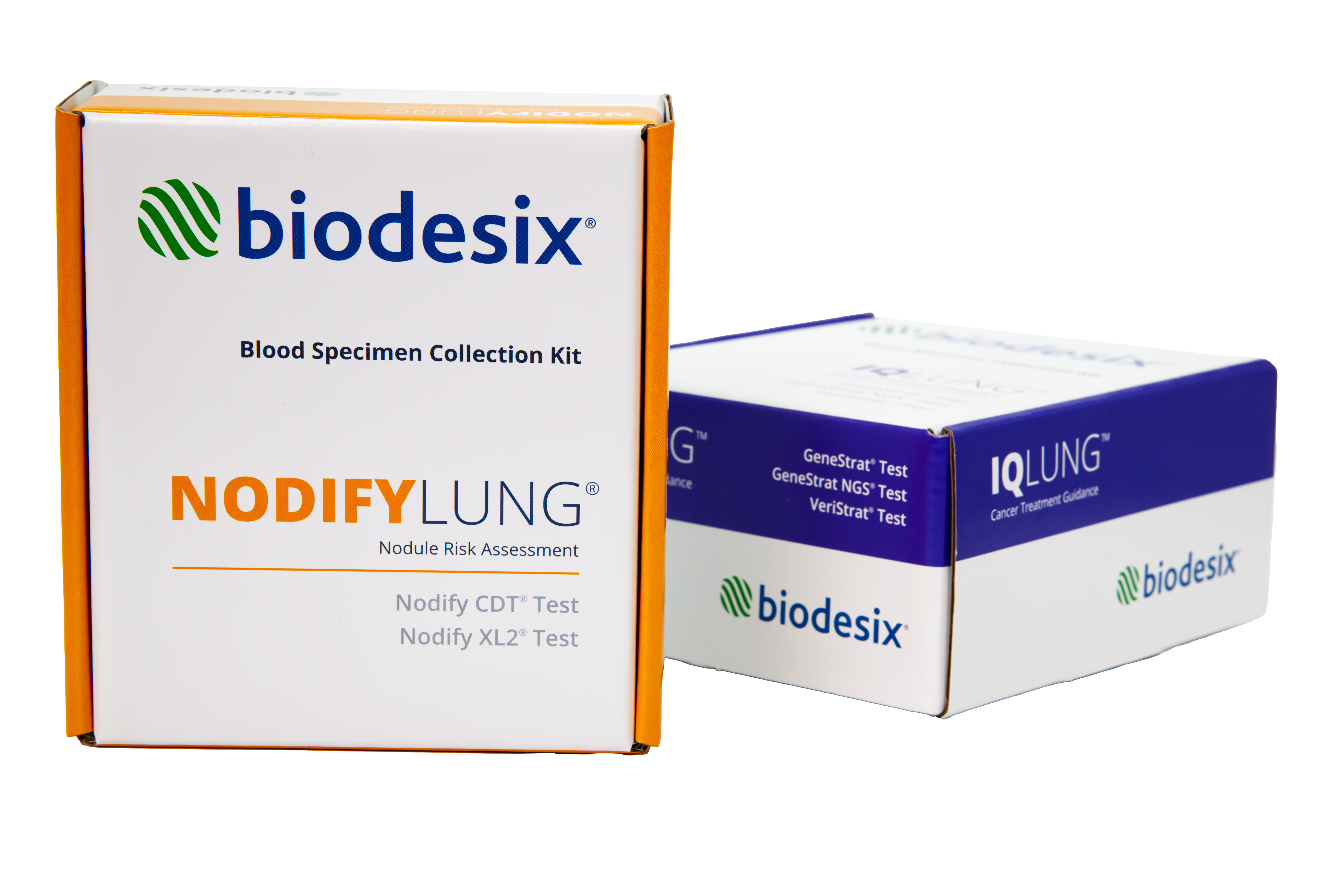
Dr. Jett: Biodesix Nodify Lung testing is a blood test that is comprised of two tests that are processed in a Biodesix Lab: Nodify CDT test and Nodify XL2 test.
- The Biodesix Nodify CDT test is run first and, if positive, it indicates that the lung nodule is of high risk and should be evaluated further, sooner rather than being delayed.
- If the Nodify CDT test shows no significant elevation of autoantibody detected in the patient’s blood and the probability of cancer is 50% or less for that patient, then the Biodesix Nodify XL2 test is performed to determine if the lung nodule is of very low risk of cancer (<5%). If so, then it can be followed with periodic CT scans (in other words, “CT surveillance”) and no immediate biopsy is recommended unless the nodule enlarges over time.
What is the difference between an MCED blood test and Biodesix Nodify Lung blood testing?
Dr. Jett: MCEDs and SCEDs are screening tests for multiple cancer types, often self-initiated by a patient. Biodesix Nodify Lung testing is part of a comprehensive medical evaluation for a patient with an indeterminate pulmonary nodule that has been identified on their lung scan.
Can the MCED or SCED test replace Biodesix Nodify Lung testing for nodule cancer risk assessment? Can the MCED or SCED test replace a CT scan for nodule identification?
Dr. Jett: No, the MCED test and SCED are insufficient and do not replace Nodify Lung testing for evaluation of an indeterminate pulmonary nodule. There are currently 5 ACS-approved cancer screening diagnostic imaging tests, including for lung cancer.
Further, the recent reports on MCEDs at ASCO 2026 did not provide discrete data findings on lung cancer screening specifically, so I will refrain from offering additional opinions without having more specific data to review.
Would you recommend an MCED test to a patient or family member?
Dr. Jett: I recommend that all individuals be up to date on their American Cancer Society (ACS)-approved diagnostic imaging screening tests. Discuss this with your doctor. The benefits versus risks of MCED tests are evolving and currently the American Society of Clinical Oncology (ASCO) does not recommend screening with a MCED test.
How is Biodesix involved in removing the societal stigma of lung cancer? How does Biodesix encourage patients to understand their lung nodules?
Dr. Jett: At Biodesix, we support educational programs that encourage patients to pay more attention to their personal lung health, and to get their lung cancer risk assessed sooner when an incidental lung nodule is found on their scan. At Biodesix our mission is based around earlier lung cancer diagnosis so that we can directly and positively impact patient care and outcomes. No one deserves to get lung cancer!
Editor’s Note:
In February 2026, Biodesix announced a peer-reviewed publication supporting the largest lung nodule biomarker clinical validation study ever conducted. This strengthens the adoption of Nodify CDT tests as a critical decision-support tool in the early detection of lung cancer, addressing a significant unmet need in the management of the millions of lung nodules detected annually in the United States. The study, published in Future Oncology, February 2026, titled Validation of a blood-based autoantibody test to assess lung cancer risk is 4–30 mm pulmonary nodules: a retrospective pooled analysis of four cohort studies, highlights that the Nodify CDT test offers consistently strong performance in identifying a high risk of lung cancer in patients with lung nodules.
Over 1,100 patients with noncalcified lung nodules ranging in size from 4–30 mm and had Nodify CDT test results were analyzed. The data shows that the Nodify CDT test consistently demonstrated high specificity (91–97%), i.e. low false positive rates, regardless of nodule size or baseline patient risk factors. Test performance was also consistent across four distinct clinical studies with patients enrolled from 48 clinical practices in the US, including the CLARIFY study (NCT06728319) where patients received the Nodify CDT test as part of real-world clinical care. These data substantiate that the Nodify CDT test has strong clinical applicability and consistent performance across diverse practice settings and various patient populations.